Feed on
Posts
Comments

Reading chapter 4 of the book A New Kind of Christian, finally read something I haven’t already heard about.  At the beginning it wasn’t promising; it talks about how technology and economic changes took the world from medieval times to modern, and how current technology and economic change will be doing the same (in which I still have some reservation on this)  But what got me thinking is this, while talking about those great grand looking cathedrals in Europe:

Ironically, the very stone buildings that expressed the belief that their medieval version of Christiandom would last forever now mock that belief because today, when we visit them in Europe, they seem to us like museums – or mausoleums.  They tell a story of a world that is over

When I was in London and Paris early last year, visiting some of the Cathedrals, I did have trouble understanding what all this is about.  I remember thinking, no doubt Christians back then spent all kinds of resources and effort to building something great for God.  But what about now, with hardly any Christians in there, so all Europeans have moved out of medieval world already.  What about other parts of the world, like Peru I visited a couple months ago, where majority is Catholic, are they still in medieval mindset? or have they moved on to something different, not quite modern or post-modern, because it’s still a developing/border-line 3rd world country?  I have also visited a few Mega churches in the states, and I remember thinking if those big grand buildings will become like Cathedrals in Europe in the future, a reminder of the old age called Modern. (I actually don’t think so, because it’s so multi-purpose, it will just be converted into something else)

Most of your peers live in a different world from you. They have already crossed the line into the postmodern world.  But few of you have.  Why? Because you want to be faithful to the Christian upbringing you have received, which is so thoroughly enmeshed with modernity.

So is this what churches are doing now, trying to have as many people as possible, to keep coming to church, trying to keep them in the Modern world mindset? Is this why many people feeling uncomfortable in church.  And what exactly am I, Modern? Post-modern? Somewhere in between?  I think it’s ok to stay with whatever I’m right now, but if I were to have children in the future, they will most likely be postmodern, how will I be dealing with that? A friend of mine has always been saying that he will let me take his kids to church (He himself doesn’t go to church) But now I think I better tell him that, in addition to the teaching of Christ and being a follower of Christ, children might be taught in a modern mindset, which could be incompatible with the rest of their peers, i.e. in a postmodern mindset. –KC

GINI 7 at Kwong T's

In another 4 days, we’ll be having another wine taste, so again I need to do a blog for the previous one (I really should’ve gotten this done much earlier) Maybe I should simply blog while we are having the wine. But then I’m not sure if there will be space for my laptop, with all the wine glasses and food on the table. This GINI time we had a pretty good turn out; 11 people were drinking this time. However, unlike previous meetings we had, this time we didn’t have a specific type of wine to try. Instead, Vincent W picked a few from the newly releases from LCBO. So we tasted 4 different wines, 3 of them are red and one is white. And since they are so different, we didn’t bother to cover up the label, or ranking them as well (although I think majority of us like the white wine a lot) And because the wine are so different, Vincent W suggested us to try them in a particular order, basically the stronger the taste, the later.


Antinori Badia A Passignano Chianti Classico Riserva 2001 (Italy)

First bottle is a Chianti. In the past, I posted whole bunch of information of each bottle. But now, I’m slowing migrating all those information to Flickr, a photo web site. So if you click on the picture above now, it’ll open up another window to Flickr and the page with that photo. We found this one quite fruity, but also tasted like wet leather (not exactly everyone’s favorite taste)

Château Bouscassé Vieilles Vignes 2000 (France)

Second bottle is from a region called Madiran in south west part of France. You can find more information here on this region. All Madirans must contain 40-60% of the local grape Tannat. I have not heard of this wine region, so it’s neat to have another geographical lesson. This bottle has a distinct taste, we thought it tasted like something out of a open bamboo shoots can. Only us Chinese can describe taste that way. Again, not exactly our favorite taste coming from a wine.

D'Arenberg Dead Arm Shiraz 2004 (Australia)

The last red we tried was a Shiraz called the Dead Arm; maybe it’s describing arms of the people after picking all the grapes. It’s definitely not as spicy as the usual Shiraz we tried before. In fact, I thought it was a little meaty, taste I find in Pinot Noir.

Zind-Humbrecht Pinot Gris Vendange Tardive 2000 (Alsace)

Finally we tried the lone white wine, a Pinot Gris Vendange Tardive, and it has this great apricot aromas. Good thing we were saving this for last to try. The French words “Vendange Tardive” we see on the label actually means “Late Harvest”. So we can expect it to be quite sweet and it was lovely. Every one of us like it almost like a dessert wine, but not that sweet. Interestingly, we tried a Pinot Gris from the same label earlier this year, and we liked that one too.


Peru – Lima

Peru – Lima
When: Day 1, 13, and 16
Location: Miraflores, Lima
Hotels:
Faraona Grand Hotel http://www.faraonagrandhotel.com/
JW Marriott Hotel Lima http://marriott.com/property/propertypage/LIMDT
Technically, we were in Lima for less than two days. We were there for 6 hours for Day 1 and half of Day 13. Day 16 was last day of our trip, and we did a quick city tour in the afternoon. So in the end, we still don’t know much about Lima. In fact, most of the time we were in one district of Lima, Miraflores, where most tourists hang around.
6 Hours of Lima
Of the 6 hours, we spent an hour getting out of the airport, one and a half hour going back and forth between the airport and our hotel, and half hour to check into our room. By then, we had about two hours before meeting up with our tour group. I knew right the way two hours of sleep won’t be much help, so I took my time, taking shower, repacking some of the clothing (putting warm clothing away for the rainforest days), and watching TV.
Hotel is called the Faraona Grand Hotel. Chosen by our tour company, it is where we join (Day 1) and depart (Day 13) the tour group. This hotel reminds me of the hotel I stayed in Honolulu last year; some of the decor and facilities seem a little dated, but it’s been well-maintained and clean. Of course I didn’t see it as clean when we first got there, but second time around, after going through rainforest and camping, it looked especially clean and comfortable.
Last day of our trip
The other hotel we stayed in Lima was the JW Marriott. It’s a 4-stars hotel, and they charge everything accordingly. A few things led us to this hotel: 1) the building itself looks interesting and beautiful, 2) I could get a corporate rate there, which is about 40% savings, 3) all rooms have ocean view. We were a little skeptical with that last claim. Turns out, most of the rooms do have nice big view of the ocean, but some of them have a small view of it. We got two rooms, one with a nice view, the other one with a tiny bit space where you can see the ocean.
But ocean view is a little overrated, especially when we were not there around sunset. Basically it is facing west, so not much to see in the morning. But sunset over the Pacific is quite lovely.
The area just in front of the hotel has a nice outdoor shopping mall called LarcoMar <http://www.larcomar.com/larcomar_index.htm>. It’s probably one of the few places in Peru where it feels like North America. It’s where we had KFC, real tasty chicken. It’s also where I had Starbucks (coffee tastes just like home, too bad they don’t have oatmeal raisin cookies) I’m sure we could’ve spent the whole day there, but we all know it’s better to do a city tour, no matter how quick and brief it is. So in the same fashion, I list the places we went, just as briefly:
  • Monumento a los Amantes (Lovers’ Monument, Miraflores)
  • Main Square in Barranco
  • Gran Hotel Bolivar, a historical hotel in Old Lima http://www.granhotelbolivarperu.com/
  • Plaza de Armas, the Main Square in Old Lima. Around the square, there is Palacio del Gobierno (Presidential Palace), Municipalidad de Lima (City Hall), and La Catedral (cathedral)
  • Convento y Museo de San Francisco, famous for its catacombs (I think Marg has a picture of the skulls)

All these places in 3 hours. Our tour leader Maria did a fine job, probably speak the best English speaking guide we met. At our request, they drove us to an area in Miraflores filled with Handicraft markets. Although I’m not big in shopping, they sell plenty of interesting things, and it’s not hard to spend a couple hours there.

Finally, before heading to the airport, we went to some fancy restaurant, Restaurant Huaca Pucllana <http://www.resthuacapucllana.com/> I had Creole Style Chupe <http://en.wikipedia.org/wiki/Chupe>, a typical Peruvian crayfish chowder. I thought the place is not bad, and the best thing about this restaurant is the view of the adobe pyramid, right outside of the building. But rest of us thought service could be better, i.e. a waiter who can speak English. It was our last day of the trip, I guess by then we all just wanted go home.

When: Day 11 and 12
Location: Puno and Lake Titicaca
Hotel: Casona Plaza Hotel http://www.casonaplazahotel.com/
After a full day of travelling in a van, we finally got to our hotel in Puno. Casona Plaza hotel is one of the better hotels we stayed in Peru. They have very nice bathroom, I know because I spent plenty of time there. That day, Nov 5, happened to be Puno Day, a local holiday. There was a parade in the streets, and our hotel was right in the middle of it. Too bad that it was all noise to me while I was resting in our hotel room. All other people went out to watch the parade and had dinner.

Puno Day Parade
Originally uploaded by Vincent Ma.
Apparently not all rooms have functional cable TV, but ours was working fine. I was basically watching English TV in my bed the whole evening; Law and Order, CSI, Gilmore Girls, House. But I was so sick I was considering staying in hotel room for the rest of the trip. Thanks to Vince, I got plenty of water and a little bit to eat, although I wasn’t really able to eat. Fortunately, I felt good enough to get out of the room the next morning; I was a little worried with the idea of sitting in a boat for a few hours.

Floating Reed Islands of Uros

First place we visited in Lake Titicaca was the floating islands. While it is true that the Uros still live on these floating islands, the ones we visited felt more like floating souvenir stands. I guess those are set up specifically for tourists, a good demostration on how these islands float. There was a stand with a post box, for people to get postcards and to sent them. I think Tyatt got one to sent to her folks, but I’m not sure if they ever got it.

Taquile Island

After the visit to the floating island, we headed to the Taquile Island. It’s about two hours of boat ride, kinda gives you an idea how big Lake Titicaca is. The island is famous for high quality handicrafts. It’s interesting that it’s the men there do the knitting, not the women (or weren’t allowed?) Everyone except me bought quite a bit of stuff there. But I like the landscape there the most, it is just different from all other places we visited in Peru. I felt I was inside of a nice piece of painting. Although there wasn’t really much to do there, I think it’s worth the time to make this trip.

Lake Titicaca, Puno, Peru
Originally uploaded by Vincent Ma.

Tres Chimbadas Oxbow Lake

One thing I can’t do with my camera is to take wildlife pictures; mainly because it doesn’t have a very good zoom, only 3x. But knowing Vince and Tyatt have a SLR camera with a good lens, I didn’t bother to take pictures of things that are a little far away, which means I got no pictures of the birds we saw in the rainforest. Here are some of the nice pictures they took:

Bird by the lake
Originally uploaded by Vincent Ma.

Another bird on a tree
Originally uploaded by Vincent Ma.

A bird drying his wings..
Originally uploaded by Vincent Ma.

Piranha, meat eating fish

Our tour guide did a good demo of piranha biting ability. Granted it was only a piece of leaf, but it left a clean sharp bite mark. I thought it was kinda funny the fish would just start biting when a leaf was placed in front of it.

Where are the monkeys?

We’ve been told that monkeys there would come to our room if they smell anything like food. But the whole time there, I didn’t see any monkeys. Even at the time the picture below taken, I was further down the path. By the time I heard that there were monkeys, I was too far away, and I was too lazy to climb all those stairs again.

Monkeys!
Originally uploaded by Vincent Ma.

Leaving Tambopata


Partial group shot
Originally uploaded by Vincent Ma.

Rio Tambopata from the air
Originally uploaded by Vincent Ma.


Ok, a break from the Peru trip.  This edition of GINI Wine Taste actually happened back in October the 21st.  I “need” to blog this now because we will be having another wine taste this weekend.  My memory is a little hazy on this October wine taste; I was super busy both at work and outside of work in October.  Needless to say, I don’t remember much from the wine we tasted.

This time around we had the lowest turnout; only 7 of us to taste 4 bottles.  Of the 4 bottles, 3 are from the same region, southern Rhône’s Châteauneuf-du-Pape, and one from Australia.  They were made from similar grape, but the Australian one should be noticeablely different.

Speaking of grapes, that’s where GSM comes in.  Of course it’s different from the GSM in wireless sense that we all know.  G being Grenache, S being Syrah, M being Mourvèdre.  We all know Syrah (or Shiraz), but not so much about the other two.

So what about Rhône and Châteauneuf-du-Pape?  I think I have tried Châteauneuf-du-Pape once, but I don’t remember.  From some website I read, Robert Parker, the well-known wine crtic, said “I probably drink more Southern Rhônes than any other kind of wines because it fits in with our cooking. These are wines that are not oaked. You can drink them young and I appreciate the purity of their fruit. I love grenache.”

From GINI Wine Tas…

Very well, so I guess I’ll try more Southern Rhônes in the future.  There is a little more information on Châteauneuf-du-Pape from LCBO’s Vintage:

For Châteauneuf-du-Pape, 13 is a lucky number. Under its Appellation Contrôlée (AC) rules, up to 13 grape varieties are permitted in its red wine. When the region was officially demarcated in 1935 (incidentially, France’s first AC), the long-established vineyards were chock-a-block with 13 different grape varieties. Rather than insisting that some varieties be uprooted, 10 of the varieties were sanctioned, with a further three added in 1936.

The lucky 13 are Grenache, Syrah, Mourvèdre, Counoise, Cinsault, Vaccarèse, Terret Noir, Muscardin, Picpoul, Clairette, Picardan, Bourboulenc and Roussanne. The last five are actually white grapes – the rarer white wines only use these. Today, few wineries actually use all 13 grapes; producers unique combinations of grapes to create wines that reflect their personal style. The only grape that all producers agree upon is Grenache. Winemakers and critics alike believe that Grenache achieves its finest expression in the vineyards of Châteauneuf. Here it can produce not just the sweet fruit for which it is known, but also the concentration that is difficult to achieve in most places in the world. After Grenache, it is Mourvèdre, Cinsault and Syrah that are the most prominent, adding a complex formula of fruit, acid, tannin. The other nine grapes are used as we would use salt and pepper in a favourite dish: as seasoning.

 Here are the three bottles from that area, and one Australian wine we tried:

Domaine de Fontavin 2001
Price: $33
Web Site: http://www.fontavin.com/chateauneuf-du-pape_red_wine.htm

From GINI Wine Tas…

Perrin & Fils Les Sinards 2001
Price: $30
The Perrin Family Weblog: http://www.perrin-et-fils.com/beaucastel/

From GINI Wine Tas…

Domaine de la Solitude 2001
Price: $37
Web Site: http://www.domaine-solitude.com/english/tradition_rouge_2000.html

Wine spectator 93 “Impressive. A sophisticated red, with a modern accent, showing vanilla, mocha, chocolate and smoke, all of which complement nicely the ripe and sweet fruit. Full-bodied, clean and racy. Harmonious finish. Drink now through 2015”

From GINI Wine Tas…

Grant Burge – The Holy Trinity 1999
Price: $35
Web Site: http://www.grantburgewines.com.au/thewines/?wine=24

Wine spectator 91 “Vivid, crisp and juicy, a mouthful of jazzy blackberry, plum, anise and leather aromas and flavors that unfold gracefully and persist into a long finish. Grenache, Shiraz and Mourvèdre. Drink now through 2008”

From GINI Wine Tas…

The GINI GSM Index

We ranked the bottles 1 to 4, add up the numbers, whichever one has the lowest score is the best.  Here is the list of participants: Aaron, Alex, Andrew, Anson, Kelvin, Kwong C, Vincent W

Bottle #

Vineyard

Region

Pts

Group Rank

My Rank

1

Perrin & Fils Les Sinards 2001

Châteauneuf-du-Pape, Rhône, France

22

4

2

2

Grant Burge – The Holy Trinity 1999

Barossa Valley, Australia

17

2

4

3

Domaine de Fontavin 2001

Châteauneuf-du-Pape, Rhône, France

14

1

1

4

Domaine de la Solitude 2001

Châteauneuf-du-Pape, Rhône, France

17

3

3


Alpaca Farm, Cusco->Puno
Originally uploaded by Vincent Ma.

When: Day 11
Location: On the road, from Cusco to Puno

In the itinerary, this day, we “enjoy spectacular views of the countryside of this full day of travel through the high Altiplano from Cuzco to Puno.” That’s it, that’s all the description for day 11. While we did spend the whole day travelling in a mini-van, I didn’t get to see much spectacular views as I was feeling sick the whole time.

A fellow tour member knew it first thing in the morning when he saw me. He asked me why did I do everything slowly. I didn’t know it at the time, but I hardly had the breath to answer him. A couple hours into travelling, my stomach hurted so bad, I couldn’t even say a word to anybody. Our tour guide saw me not doing so good, so he stopped the van and let me out for a breather. I thought I felt a bit better and got back on the van and continue the ride. Next thing I know, I started throwing up. The driver stopped the van right the way and let me out (or maybe more like kicking me out), falling on my knees, I let it all out. Last time I vomit, it was probably back in HK when I was a kid. Anyway, I felt much better after all of my breakfast and the dinner last night came out; I could speak again. I asked for some wet napkins and sort of clean up.

The floor near the driver was a mess; I guess it was good thing that I sat in the front at that time. A little easier for the driver to clean up; it would’ve been real ugly if it was at the back of the van. I didn’t vomit for the rest of the trip, but my stomach still hurt quite a bit, and I kept wanting to go to the toilet, thinking it may relieve a bit. That’s why when we got to the Alpaca farm, I spent the whole time in the bathroom. I’ve gotta say, they have the nicest bathroom the whole countryside. Reason being, the Alpaca farm is really catering to Japanese tourists, selling some nice alpaca products. So while I was struggling in the bathroom, rest of the group were having some fun with the alpacas there.

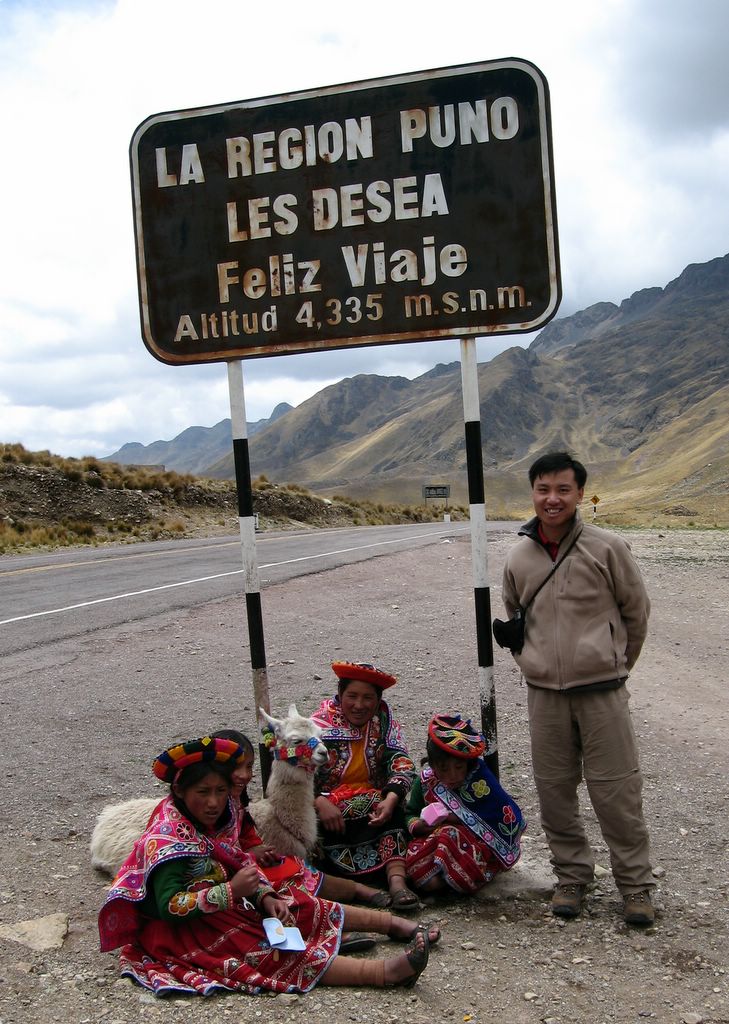
Two things I can blame my misfortune on: High Altitude and Tiramisu; the whole way between Cusco and Puno is at high altitude. Cusco is at 11600 feet altitude, and Puno is at 12628. In fact, we took a brief stop at the highest point of the whole trip, 4335m, or 14222 feet. Thanks to the tour guide, I managed to get a photo of me standing next to the sign.

From Puno – Lake Titikaka

It was my lowlight of the trip, but it was definitely an unforgettable experience. I will definitely be more careful of what I eat while travelling (what was I thinking, Tiramisu in Peru?) Peru’s highland region really does have some nice countryside views, too bad I was holding my belly most of the time, instead of my camera.

From Puno – Lake Titikaka

When: Day 2 to 4 (2 nights)
Location: Closest city Puerto Maldonado; half hour drive to the Tambopata River, then an hour boat ride up the river
More Info: http://www.perunature.com/lodges_pa.php
Before going on this trip, a friend of mine and I were talking about the rainforest jungle part of the trip. He was wondering if I would need to paddle the boat, to get to the lodge. Well, that got me worried a little too, images of the TV show Survivor started coming to my mind, I hope I won’t get myself and my backpack all wet, or worse, having to swim (there are meat-eating fishes)
Actually I think I enjoy the boat ride the most there. With the breeze blowing, it is the coolest place to be in the rainforest. And since we always seem to be on a boat during sunrise/sunset time, I get to take some nice pictures. It’s too bad that the rest of the rainforest trip was a blur to me, having less than 2 hours of sleep the night before. For more detailed description of this little visit, it can be found at this link: http://www.perunature.com/tours.php We basically followed the iternary pretty closely, except we didn’t get to visit the parakeet clay lick because it was raining hard at one point; it would be nice to see the macaws and parrots.
The lodge there is quite amazing; it exceeds all my expectations, or maybe lack of any. It kinda reminds me of Hawaii (ok, maybe not as nice) but the room, the lounge, the dining hall were all very nice and clean. Our tour guides there, Carol and Augusto, did a very good job taking us to places and explaining plants and insects to us.
As much as I enjoy the time there, I’m not a big fan of bird watching or looking at nature, so two nights in the lodge is really quite enough for me.
Final note: on our flight leaving the rainforest, I was chatting with a Slovenkia woman sitting next to me. She commented that she knows an Asian friend from Toronto, speaking Ensligh the same way me and Vince do. I guess there is such a thing as Toronto Asian accent.

Before going on this trip, I spent quite a bit of time and money on getting stuff in preparing for the trip.  It turns out not everything I got was that useful.  In fact, there were times we had to re-pack our luggages and leave behind some of the stuff at the hotel, so I was well aware of what things I did not use at all.  Here is my rating of the stuff I brought with me to Peru:

Backpack cover (C-)
– would have been useful if we actually bring our big backpacks to the jungle and Inca Trail, but they were in hotel most of the time, never in danger of getting wet

Waterproof daypack (A-)
– it’s actually a little big for daypack, but I was carrying it everywhere, and it does keep everything dry in there

Travel quick dry towels (B-)
– used them once in camping on the trail; it does absorb water pretty quickly, but I forgot to wash them before using them for the first time, so it was a little dirty

Hiking boots (A+)
– love my new hiking boots; Gore-tex, waterproof and all; my feet were never in pain

Hiking socks (A+)
– 4 pairs for daily walking (and quick dry after wash), 4 pairs for more hardcore hiking; worked out very good, worth the money I spent (more than $40)

Knee-length socks (C-)
– only pair of socks I didn’t use; it was meant for using with rubber boots they have in the jungle, but I just keep using my hiking boots

Inner sheet for sleeping bag (C-)
– any bed sheets would’ve worked

Thermal underwear/tights (C-)
– it was never that cold, so they were left untouched

Travel underwear (B+)
– there was almost no need for these quick dry after wash underwear; I used hotel laundry service twice, but I did have to wash them myself once.  They did get dry pretty quickly

Windproof/waterproof jacket (A+)
– love my new Gore-tex XCR jacket, a must while hiking in the rain

Binoculars (B-)
– my cheap binoculars helped me a bit on bird watching in the jungle

Head Flashlight (A+)
– very useful in the jungle and the trail at night

Compass (C-)
– never had to use it; tour guides know their way

Water proof camera case (B-)
– I almost had to use it in Machu Picchu; other than that, there was really no need

Rain poncho (B-)
– used it once while in the jungle; served its purpose

Walking Stick (A-)
– very useful hiking uphill; not so much going downhill

I just found that out the hard way.  I was so close to uploading them all; just 20+ more pictures of Lima.  Oh well, I guess I’ll have to wait for another 2 weeks or so.

« Newer Posts - Older Posts »