Feed on
Posts
Comments

One of the Rieslings we had in GINI 11 is Domaine Weinbach Riesling Schlossberg Cuvee Sainte Catherine Riesling from Alsace.  First, I want to decode the words here.  Domaine Weinbach is the producer. Schlossberg is castle hill in German. Cuvée is same as the English word Reserve.  In Rhone Valley, producers produce special, deluxe lots of wine or a lot of wine from a specific grape variety that they bottle separately.  These lots are often referred to as cuvées. ((Wein-Bauer, Inc.)) So I guess Sainte Catherine is the name of the reserve lots.  According to the producer’s website, it situated half way on the Schlossberg slope. ((Domaine Weinbach))

I have always thought Alsace is a region in Germany, because Riesling is well-known in Germany.  Alsace is part of France, but it was part of Germany before.  In fact it changed hands a few times.  Riesling is probably best of Alsace’s varieties.  It is clean, apple and lemon scents, and it can smell like petrol (in a good way they say)

The other Riesling we tried was Joh Jos Prum Riesling Spätlese Graacher Himmelreich Riesling.  Another decoding is needed.  The producer is Johann Josef Prüm (Joh Jos Prüm).  Spätlese is Late Harvest in German.  Himmelreich is the name of the vineyard, which is in a town called Gracch.  So the word Graacher on the label is to Graach as New Yorker is to New York.  Finally, the region is called Mosel-Saar-Ruwer (MOE-zul Zahr ROO-ver).  The Saar and Ruwer rivers are both tributaries (streams) of the Mosel, which is the main river in this region. ((Immer, Andrea. Great Wine Made Simple, New York, 2000. Pg 246-247))  Riesling from Mosel is often described as floral, racy, elegant and finesse; very much like perfume.

One thing I failed to mentioned in my previous post was that our 2nd bottle, Domaine Etienne Sauzet Puligny Montrachet Champ Gain, is a Chardonnay. There is two way to know this, the hard way is to do a bit of research (internet, library books), the easy way is to ask Vincent W. Well, I did both, not that I doubt Vincent’s wine knowledge, but doing research is kinda fun. Looking at the wine label, Domaine Etienne Sauzet Puligny Montrachet Champ Gain, I know one word only….

It turns out, Domaine Etienne Sauzet is the name of the producer (I have no clue if it is well-known). It was called “benchmark Burgundian Domaine” ((Justerini & Brooks: Etienne Sauzet))As for Puligny Montrachet, it’s a town “where many feel the finest dry white wines in the world are produced” ((Burgundy Wine Company: The Wines of Puligny-Montrachet)) Wow… now I know Vincent only get the good stuff. And I’ve read similar comment about Puligny Montrachet in different sources (internet, books) So where is this place… in Burgundy of course, being a Burgundian wine.

Burgundy wine can be divided into two groups, classics and the rest. Under the classics (and the best), there are the Cote d’Or and Chablis. Chablis is almost all Chardonnay, but that’s not where Puligny Montrachet is; it’s under Cote d’Or (means “golden slope”, referring the slope where the vineyards are found) (( Immer, Andrea. Great Wine Made Simple, New York, 2000. Pg 169-172 )) Cote d’Or can be divided further into two area, both name after a major town, Cote de Nuits (Coat duh NWEE) and Cote de Beaune (Coat duh BONE). So… Puligny Montrachet belongs to Cote de Beaune. (Big deal…) Finally, Champ Gain is the name of the vineyard…

So here it is, Domaine Etienne Sauzet Puligny Montrachet Champ Gain, I know what it means now. (Pronouncing it is another matter)

Since the last time I wrote, which is more than 4 months ago, we had 4 more wine tastings.  So we have been consistently drinking, but I have not been consistently writing.  So I have quite a bit of catching up to do here…

We had GINI 11 back in May 11, at Vincent W’s place.  Since we were having white wine this time around, we figured we would like some seafood to go with it, so we ended up getting sashimi/sushi.  Originally we were going to have some Italian red wine, but since Vincent M, a big fan of Italian Red, couldn’t make it, we postponed those red wines until GINI 12.  Anyway, here are the white wines:

  1. Le Clos Jordanne Village Reserve Chardonnay 2004 (Niagara)
  2. Domaine Etienne Sauzet Puligny Montrachet Champ Gain 2004 (Burgundy)
  3. Domaine Weinbach Riesling Schlossberg Cuvee Sainte Catherine Riesling 2005 (Alsace)
  4. Joh Jos Prum Riesling Spatlese Graacher Himmelreich Riesling 2003 (Mosel-Saar-Ruwer, Germany)

During the 4 months that I was not writing, Andrew actually set up another blog to make notes for each wine we tried in GINI tastings.  <http://www.seatourist.com/gini-wine-tasting/> Since he is doing a great job with the taste notes, I’ll get lazy and not writing taste notes.  But I would post the results of voting for our favorite wine of each tasting.

The GINI Chardonnay/Riesling Index
We ranked the bottles 1 to 4, add up the numbers, whichever one has the lowest score is the best.  Here is the list of participants: Aaron, Alex, Andrew, Kwong C, Kwong T, Naomi, Rita, Stephanie, Vincent W.  Looking at the results, there was no clear winner; in fact 3 bottles got the same score, and the 4th one was just 2 points off.

Bottle #

Vineyard Region Pts Group Rank My Rank
1 Le Clos Jordanne Village Reserve Chardonnay 2004
Niagara
22 T1 3
2 Domaine Etienne Sauzet, Champ Gain 2004
Puligny Montrachet, Burgundy
22 2 4
3 Domaine Weinbach Riesling Schlossberg Cuvee Sainte Catherine Riesling 2005
Alsace,
France
22 T1 2
4 Joh Jos Prum Riesling Spatlese Graacher Himmelreich Riesling 2003
Mosel-Saar-Ruwer, Germany
24 4 1

Canada’s greatest pinot noir, that’s how one newspaper columnist compliments wines from Le Clos Jordanne.  It just happens that first wide release of their debut vintage is on the same day as our wine tasting day.  So we tasted 4 bottles of Pinot Noir from LCJ’s 3 different vineyards.  Two of the bottles are from the same vineyard, Le Clos Jordanne Vineyard, but one, called Le Grand Clos, is created from the vineyard’s best parcel.  So accordingly it is more expensive, priced at $60 as opposed to $35 for each of the rest.

We actually weren’t all that sure if we can try all 4 bottles, because there are not that many around; only 470 cases of 6 were made for Le Grand Clos, the most expensive one.  Even for one of the $35 ones, Claystone Terrace, only 798 cases of 6 were made.  But because of the hard work of Vincent W and Naomi, we got all 4 bottles.  Unfortunately, they could secured one of each only.

We did have full meal this time; in addition to the rotisserie chicken Andrew brought over, my parents prepared some soup and Taiwanese sasuage.  My dad even prepared some Chinese “Kung-fu” tea for us, but that’s after we finished our wine.

Also this time we did blind tasting.  Since all 4 bottles are from the same winemaker, same year, we thought it might be a challenge for us inexperience drinker to find the differences between them.  Thankfully that is not the case; in fact they came from 3 different vineyards.  And so there are 2 bottles from the same vineyard.  Hence another challenge to ourselves is to identify which two are from the same vineyard.  Finally, we also want to identify which one of them is the especially expensive one.

Bottle #1 was the La Petite Vineyard; and we all thought it is decidedly inferior to the rest.  Maybe it has resemblances of Canadian wines, which is we were looking for.  Reviews had been noted that LCJ is actually more like the Old World than the New World.  Bottle #2 was from the Le Clos Jordanne Vineyard.  This is one of the two that come from the same vineyard.  Most of us didn’t think that would be the case.  That’s probably because it was bottle #3 and #4 that really stand out.  Most of us thought #3 and #4 were from the same vineyard; both of them were so good they were like those nice Burgundy.  But in fact it is bottle #4, Le Grand Clos, that is also from the Le Clos Jordanne Vineyard.  #3 is from the Claystone Terrace.  We actually saw the area map of where the vineyards are.  Although they are all close to each other, but because of the area’s microclimate, climates differs in such small area.  Hence the wines were not all the same.

It turns out that it was #4, Le Grand Clos, that is the most expensive one.  Vincent W noted that it is the finish that distinguishes Le Grand Clos from the other ones.  But given that most of us like both Claystone (#3) and Le Grand, Claystone is definitely a better buy.  But it’s going to be hard find now. –KC


The GINI Le Clos Jordanne Pinot Noir Index

Bottle #

Vineyard

Region

Pts

Group Rank

My Rank

1

La Petite

Niagara Peninsula, Ontario

20

4

4

2

Le Clos Jordanne

Niagara Peninsula, Ontario

14

3

3

3

Claystone Terrace

Niagara Peninsula, Ontario

7

1

1

4

Le Grand Clos (Le Clos Jordanne)

Niagara Peninsula, Ontario

9

2

2


Dad’s Chinese Kung-fu Tea never fails to impress


Being Decisive

I was reading The Economist the other day, there is a special section, a survey of the brain.  I didn’t think I would be reading much of it (I’m lost when it comes to biology).  But then there is one article called “Captain Kirk’s revenge – Emotion is essential to human survival”, and I thought it was interesting.  Near the end of the article, it talks about one interesting case:

Elliot was a responsible individual with a good job (and in his case a family, too) before he suffered his brain damage. The outcome was somewhat different in that Elliot did not become a foul-mouthed wastrel; rather, he became obsessed with detail and stopped being able to make sensible decisions. The overall result was similar, though. He lost his job and his wife and ended up an outcast.

At first, Dr Damasio thought that Elliot’s tumour had damaged his reason (both lesion studies and fMRI have shown that the frontal cortex is also the seat of the brain’s reasoning powers). Tests, however, showed that what had gone instead were his emotions. Elliot no longer felt anything, and although he could summarise the choices available in a given situation as well as anyone else, without his emotions to guide him he could not actually make a choice. And, as probably happened with Gage, that loss of emotion also changed his self. ((The Economist. London: Dec 23, 2006. Vol. 381, Iss. 8509;  pg. 6))

I guess whenever I am being indecisive, it is usually the case where I have no strong emotion/feelings toward any of the available options, e.g. where to go for lunch after the church service (the burning question every Sunday)  Maybe emotion is what Artificial Intelligence lacking; there might be cases where a robot analyize all that there is without coming up with a conclusion/decision.  Maybe that is one reason why Data from Star Trek always wanted to have the emotion capability. –KC

Back to my old self, next wine taste is coming in less than a week, and I have yet to write an entry for the previous wine taste.  But what is worse is that I don’t remember much from GINI IX.  I do remember turnout was low, so few people that we can only tried 3 bottles.  I also did not take the pictures myself, as I forgot my camera; so all pictures came from Naomi’s camera.

Unlike previous times, we did not have full meal to go with the wine; but our host Andrew did prepare some nice snack (sushi, crackers, cheese), and of course we cleaned them up quite good. Not only did I not take any pictures, I didn’t write down any notes while trying the wines.

For bottle 1, it was 1999 Shafer Red Shoulder Ranch Chardonnay Carneros.  Right the way, Naomi tasted a little salty/buttery.  She was wondering how could it be, since she has not had any of the snack.  I myself didn’t taste much of buttery, maybe a little bit. Our 2nd bottle is 2004 Saintsbury Chardonnay Carneros.  I found this one refreshing and more oaky (or buttery?)  I guess I enjoyed this one the more.

1999 Shafer Red Shoulder Ranch Chardonnay Carneros (California)


2004 Saintsbury Chardonnay Carneros  (California)


Our last bottle is 1999 William Fevre Chablis Premier Cru Montee De Tonnerre.  I believe this is my first time having Chablis (although we did try a white Burgundy before).  It is I have looked up what the WSJ writers have to say about Chablis:

Chablis is one of the natural wonders of the wine world, but it’s not appreciated much in the U.S. Partly that’s because, for a long time, winemakers slapped “Chablis” on the label of every cheap, generic white that had the misfortune of being bottled. And partly that’s because Chablis, at one point, was a chic “glass of white wine” at cocktail parties, and it suffered because Chablis, which has lovely acids, is never at its best without food.

Chablis is made from the Chardonnay grape, but it’s very different from most American Chardonnay. It’s dry and clean and somewhat austere, with crisp, flinty tastes. Some have a taste of minerals and, in the best ones, there’s an intensity of fruit that makes them seem almost tight. Most notably, there’s a little something in the “nose” and the taste that we always refer to as sourness. We know “sour” doesn’t sound very attractive in reference to a wine, but think of a perfectly ripe, very fresh lime drizzled over a crisp, savory slice of Granny Smith apple and you’ll get the idea. ((Wall Street Journal. (Eastern edition). New York, N.Y.: Jun 8, 2001.  pg. W.13))


1999 William Fevre Chablis Premier Cru Montee De Tonnerre (Burgundy)


In their article, they actually tried 1998 William Fevre Chablis, and they were quite happy with it.  Unfortunately, not many of us like our 1999 William Fevre.  Maybe we just prefer the American Chardonnay. –KC

The GINI Chablis/Chardonnay Index

Bottle #

Vineyard

Region

Pts

Group Rank

My Rank

1

1999 Shafer Red Shoulder Ranch Chardonnay Carneros

Napa Valley, Carneros

12

2

2

2

2004 Saintsbury Chardonnay Carneros

Napa Valley, Carneros

10

1

1

3

1999 William Fevre Chablis Premier Cru Montee De Tonnerre

Burgundy, France

20

3

3


We don’t even know when our next GINI going to be, and I’m writing this blog (What’s going on??)  Actually I’ve meant to write as soon as we had our last tasting, but somehow I just rather to write something else.  I was more excited than usual coming to this wine taste, reason being, I was bringing one bottle from my “collection” (all of 3 bottles)  I have this Pinot Noir I bought about one year ago.  I bought it because I read it in a wine column from the Wall Street Journal.  The column was describing their wine country trip in Napa Valley.  So of all the wine they mentioned, LCBO carried only one of them, the Pinot Noir from Russian River Valley.  It wasn’t cheap, well above $40, but I bought two anyway.  I gave one to my dad, and to my surprise, he finished rather quickly, and I didn’t even have a sip.  I can only assume that it was good, him finishing it so quickly.

Precise Pouring

We had this wine taste on December 29, a Friday night, so naturally we had dinner as well.  To go with Burgundy and Pinot Noir, we went with rotisserie chicken.  We were gonna have Swiss Charlet, but Aaron read an article from Toronto Star, recommending a BBQ place and calls it the best rotisserie chicken in Toronto area.  The place is called “Joe Boo’s Cookoos” and it’s actually in Thornhill.  It was indeed very good chicken.  BTW, thanks to Kwong T for providing his place, allowing us to eat and drink.
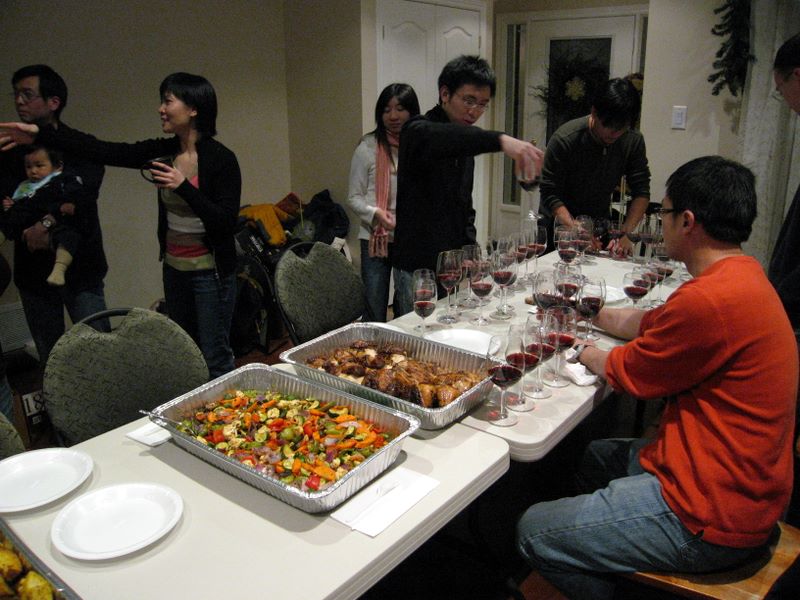
Setting up table

Broken Cork

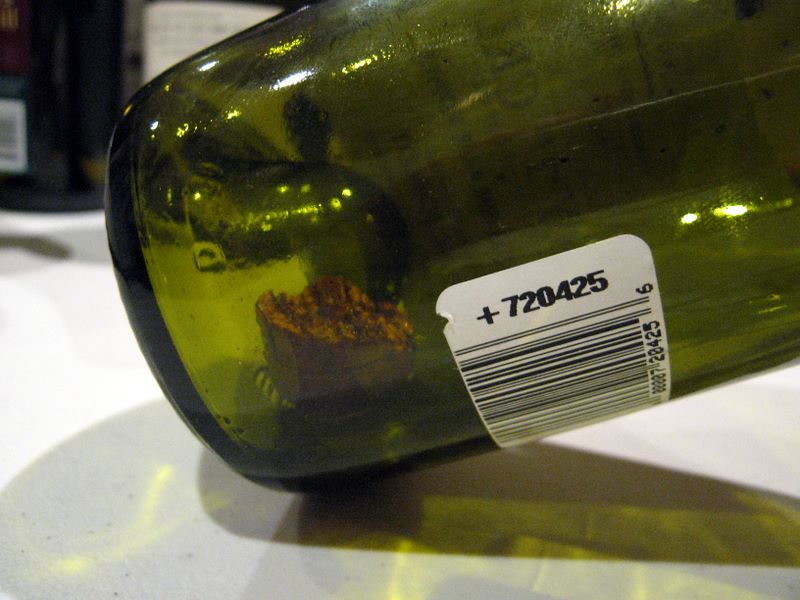
We went back to the blind tasting this time, so all bottles with brown bags covered up.  We just know one thing before hand; bottle number two had a broken cork in it (first time happen to us!) So we ended up having to decant the wine (to avoid getting the cork while drinking)  But Vincent W says that you don’t usually need to decant Pinot Noir/Burgundy.

Iris Hill Pinot Noir 2004 (Oregon)

First bottle is a Pinot Noir from Oregon.  A few of us were quite certain of it while blind tasting.  It is the youngest of all, and It was quite fruity and acidic; it didn’t taste much like other Pinot Noir we had before.

Givry 1.Cru rouge Cellier aux Moines, Domaine Joblot 1999 (Burgundy)

Second bottle was a Burgundy, the one with the broken cork.  The reason we tasted Burgundy with other Pinot Noir is that most wines from Burgundy are made from Pinot Noir.  There is a few things to learn from looking at the label.  One thing is that French for Burgundy is “Bourgogne”.  Another thing is that, in most cases, the more specific the place, the better the wine.  So in our case, Givry is the name of a village, quite specific.  1er Cru, or Premier Cru, indicates the status of the wine; only 10 percent of all Burgundy’s wine.  It ranks second to Grand Cru, which represents fewer than 2 percent of Burgundy wines.  I also found out that the terms are reversed in Bordeaux, with Premier Cru superior.  A few of us thought this one was quite different from bottle #3 and #4, so we speculate that this one is my California Pinot Noir, not Burgundy.  I’m not sure how others tasted this bottle, leather is the only one thing came to my mind.

Sebastopol Vineyards Dutton Ranch Pinot Noir 2001 (California)

Third bottle is the one I brought, Sebastopol Vineyards Dutton Ranch Pinot Noir.  I read it somewhere that a lot of wine drinkers had their first revelation about wine with Burgundy.  I think this might be the case for me, except it’s not a Burgundy, it’s Russian River Pinot Noir (close enough?)  This was my first time being so decisive and say, “this one tastes really good”  And apparently quite a few others agreed with me, looking at everyone’s rankings.  But I’m still not totally sure, as that one great taste only happened to me a couple sip; I wonder if it’s the way I’m drinking it.  In any case, I’m glad that I really like that taste… that indescrible taste.  I re-read the column in WSJ, I realize they describe it perfectly; soulful tastes of truffles and strong tea.  Yes! That’s what I tasted.

Nuits St Georges, Les Grandes Vignes, Domaine Daniel Rion et Fils 1999 (Burgundy)

Finally the last bottle is a Burgundy.  Nuits Saint Georges, name of another village, is also Preimer Cru (I believe)  Truth be told, I was so impressed by the previous bottle, I kinda forgot about this one. –KC


The GINI Burgundy/Pinot Noir Index

Bottle #

Vineyard

Region

Pts

Group Rank

My Rank

1

Iris Hill Pinot Noir 2004

Oregon

35

4

4

2

Domaine Joblot 1999

France, Burgundy, Givry

29

3

3

3

Sebastopol Vineyards Dutton Ranch Pinot Noir 2001

Napa Valley, Russian River Valley

19

1

1

4

Domaine Daniel Rion et Fils 1999

France, Burgundy, Nuits St Georges

27

2

2

Burgundy and Pinot Noir

Ever since I saw the movie A Prairie Home Companion, I got hooked on listening to the actual radio program.  So much so I go back to their archives and listen to their old shows (and wouldn’t shut up and keep telling my friends that I’m listening to the program.)  Maybe it’s their silly radio-acting with exaggerating sound-effects, but it’s more likely because of the music they play on the show.  It’s sometimes jazzy, sometimes blues, sometimes folk music.  Anyway, there is this one song I like from the show, I’d like to keep a note on.  The song was performed by Kate Mackenzie in a show about 10 years ago(!) at 1:16:27.

A Grown Woman (A Woman Like Me)
by Greg Brown and Kate Mackenzie

A grown woman, a woman like me,
Walks alone in the evenin’
   thinkin’ ’bout her baby,
Not the one who left when things got to where
   they just couldn’t understand,
No, the one she used to carry
   who’s now grown up to be almost a man.

A grown woman, a woman like me,
Can still see him come a-runnin’
   and hollerin’ for mommy,
Hope the love she’s given him
   will help him understand,
How to really give love back,
   how to be a kind and a gentle man.

A grown woman, a woman like me,
Turns off the porch light,
   wishes on the first star that she sees,
Oh, please lord, take care of him,
   for I have done all that I can,
Now he’s out there with his all kinds of dreams
   of what it is to be a man.

Just some more notes after reading the book A New Kind of Christian.

The people who talk the most about God are the ones most in danger of taking him for granted, of letting God become just a comfortable word in their lexicon, a piece of furniture, rather than a reality, a friend, a constant surprise.  The people who talk the most about loving God are the ones most in danger of being PROUD of how much they love him. The people who speak most vehemently against sin are the most in danger of feeling superior to those whose sins they excoriate, thus falling prey to an even more horrible, subtle species of sin. And since they preach so hard against sin, they are also the most in danger of yielding to the temptation to hide the sins they themselves commit.

I think this is particular true; we have seen some pretty bad church scandals in recent years.  Personally I think I have a different problem, if not opposite; I find it uncomfortable for me to speak or “preach” to others, in the back of my mind, I’m not doing a particular good job of resisting temptation of sin.  Otherwise, it would be like, Do as I say, Not do as I do.

Do you think that God would want a heaven filled with people who cared more about being saved from hell than saved from sin? Who cared more about getting their butts into heaven than being good? Who cared more about having their sins forgiven than being good neighbors? Who in fact became worse neighbors precisely because they became so religious in their concern about their own personal souls?

I could imagine Maggie saying or asking these kinds of questions; in fact, she probably did use some of these exact words long time ago.  Unfortunately I was just getting comfortable being a “Modern” Christian, brushing off her questions and doubts.  I guess I am reading this book 7 years too late (or this book came out 2 years too late, strange relief I found)  It turns out Maggie was ahead of us when it comes to being postmodern. –KC


I sort of got stuck at chapter 11 of the book New Kind of Christian.  Not that I am having trouble with what McLaren is saying, it’s just that I want to write down some of the stuff from that chapter, before reading too far ahead.

Modernity had a great insight: every individual is valuable and deserves respect. But our individualism has become unbalanced, and we have lost the realization of how connected we are.

I’m sure most Christians know it. But the following is new to me:

The only kinds of sin we want to focus on as modern Christians are the isolated individual sins committed by isolated individual monads: lying, having an abortion, indulging in pornography, taking drugs, saying naughty words. Not to minimize those things in any way, but that is far short of a fully biblical understanding of sin, and it leads to dangerous truncations of justice and compassion.

Then McLaren went on with an example of how an individual sin (more specifically committing a crime) was really in part a result of him being neglected by his community earlier in his life.  And then with that, McLaren went on to compare this with the Good Samaritan story, how the community failed to be the Good Samaritan. In fact, the community is more like the self-righteous priest or Pharisees.

The issue isn’t who is wrong or righteous; that’s obvious. The issue is who is truly good.

I guess the whole idea of concentrating on sins committed by individuals is that, if no individual commit any sin, then all is fine, at least at that moment. But that doesn’t mean people are good to each other.  So without goodness, people will face temptation to sin sooner or later.  So is McLaren saying that, not being good is just another type of sin? And if the majority of community fails to show goodness, it is the community as a whole commits the sin.

It might be true, as McLaren points out, that people with Post-modern mindset don’t necessary see themselves as isolated monads.  But I think there is still strong individualism in them. I think it is hard enough already to tell an individual to repent, not to sin, will it be any easier to ask one to go beyond righteousness and be truly good most of the time, if not all.

The difference between modern and post-modern is probably most evident in their perspective on lying, one of the individual sins mentioned before. It is black and white for the modern mindset.  Only recently I began to think it is not so clear cut.  Maybe there is a bit of post-modern in me.  But I do think it is reckless to be brutally honest all the time; it could even be mean spirit.  And of course non-believers can always accuse Christians being hypocrites with this issue; it is not surprising that people have a hard time to be a Christ follower if we focus on individual sin, like lying, only. -KC

« Newer Posts - Older Posts »